ROBOT LEARNING · RESEARCH PROJECT
Generalizable gentle grasping
from stress-aware demonstrations.
StressLess uses a finite-element stress objective to synthesize demonstrations at scale, then learns a single point-cloud policy that transfers to fragile and deformable objects in the real world.
01 · METHOD
Plan with stress.
Learn with breadth.
A distributed-pad contact model and soft-body FEM surrogate score candidate grasp poses and closing widths. Randomized pose, size, shape, and material produce over 6k demonstrations across 34 categories without human tele-operation. A single point-cloud diffusion policy observes one external depth camera and robot proprioception; no tactile or force feedback is used.
Contributions
- A stress-aware grasp planner that selects both grasp location and closing width for deformable items.
- A single policy spanning diverse fragile and deformable categories from point-cloud observations alone.
- A 275-trial real-world evaluation across categories and variations in pose, size, and shape.
02 · RESULTS
Lift objects.
Keep them intact.
Real-world scores are averaged across 11 categories and two evaluators. Lift is normalized lift height; Safe is a lift-conditioned damage score; S-Lift averages both.
| Method | Lift ↑ | Safe ↑ | S-Lift ↑ |
|---|---|---|---|
| StressLess (ours) | 0.67 | 0.78 | 0.73 |
| RGB-finetune | 0.48 | 0.67 | 0.58 |
| RGB-scratch | 0.57 | 0.67 | 0.62 |
| Point-cloud DP | 0.43 | 0.67 | 0.55 |
| RGB-frozen | 0.18 | 0.53 | 0.36 |
StressLess also retries: 25 of 31 first-attempt failures were retried, recovering 10 lifts and contributing 0.18 to the overall Lift score.
03 · FIGURES
Across simulation
and reality.
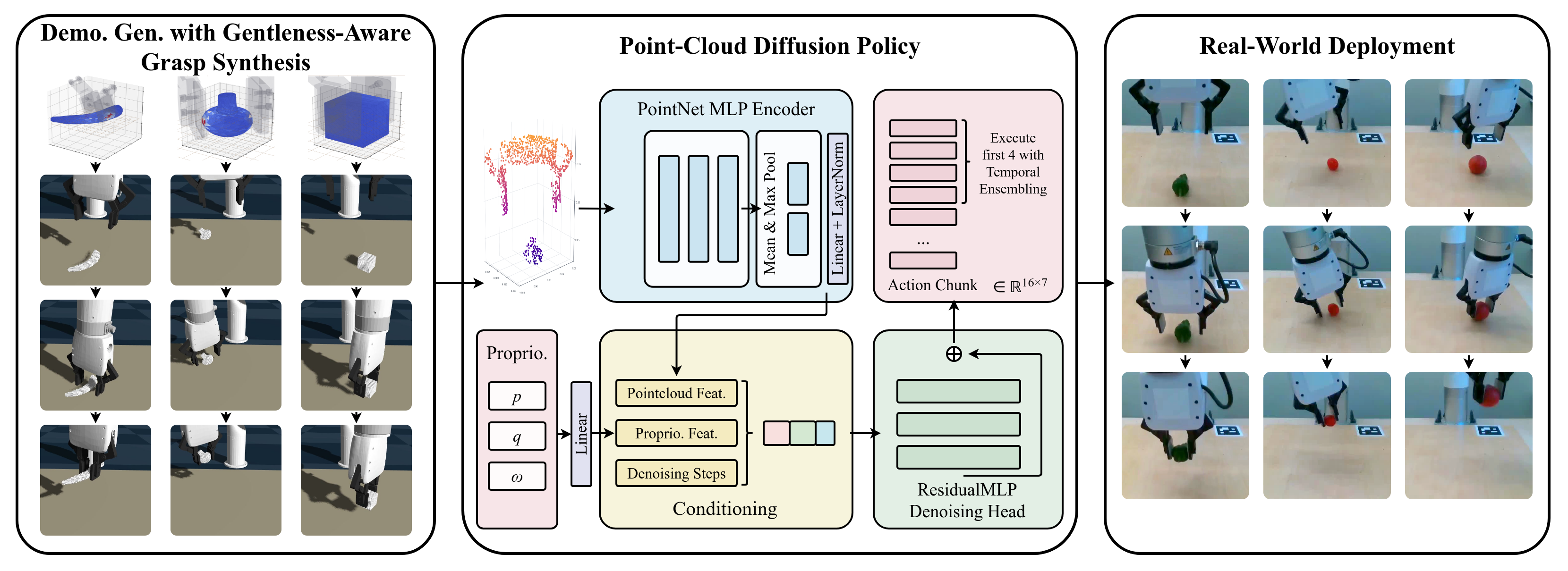
Method overview
Stress-aware demonstration generation, point-cloud policy learning, and real-world deployment.
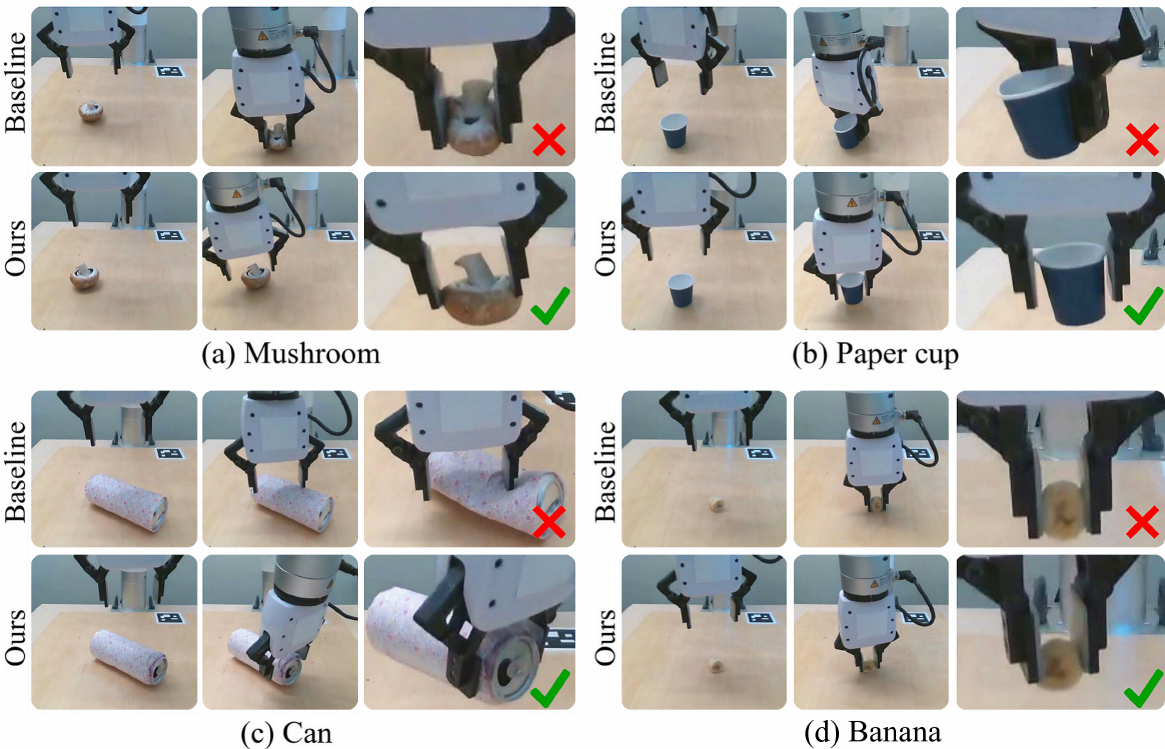
Stress-aware grasping
The latest teaser figure from the manuscript.
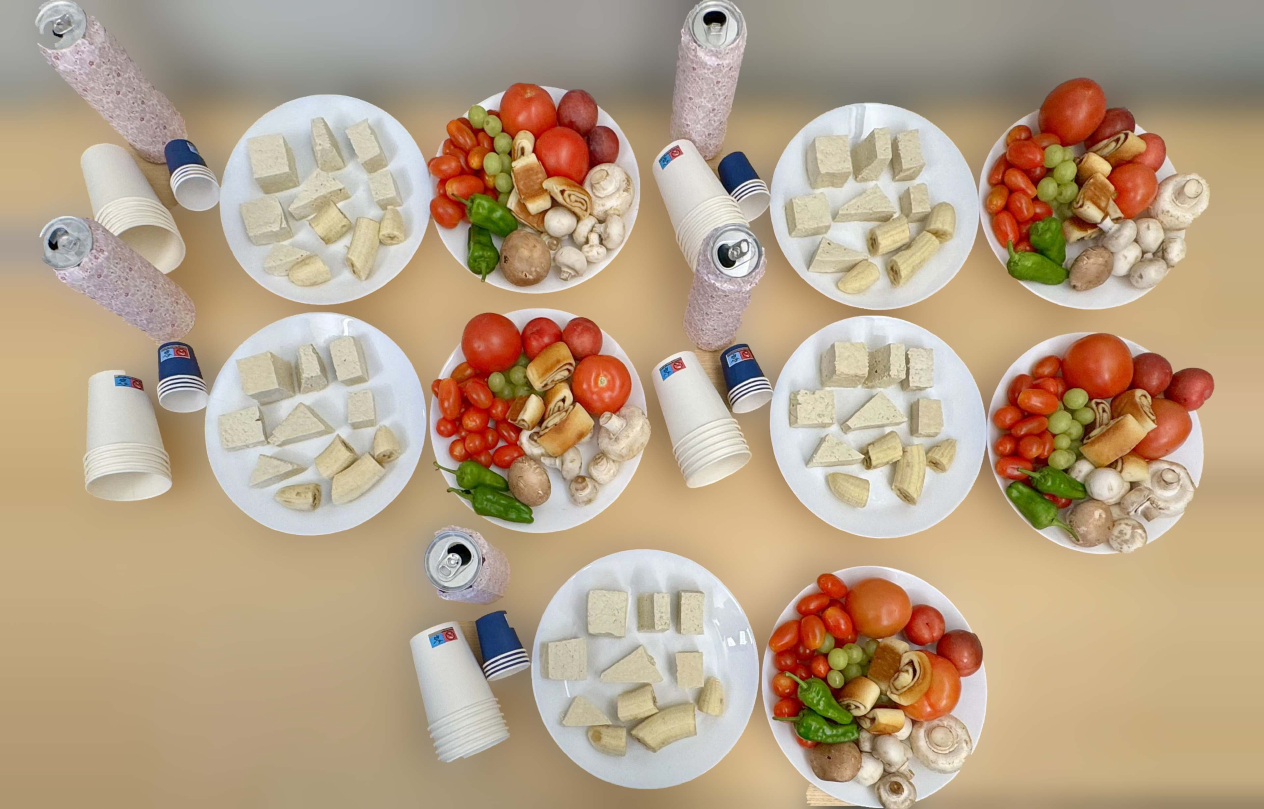
Evaluation set
Eleven fragile and deformable object categories used in real-world evaluation.
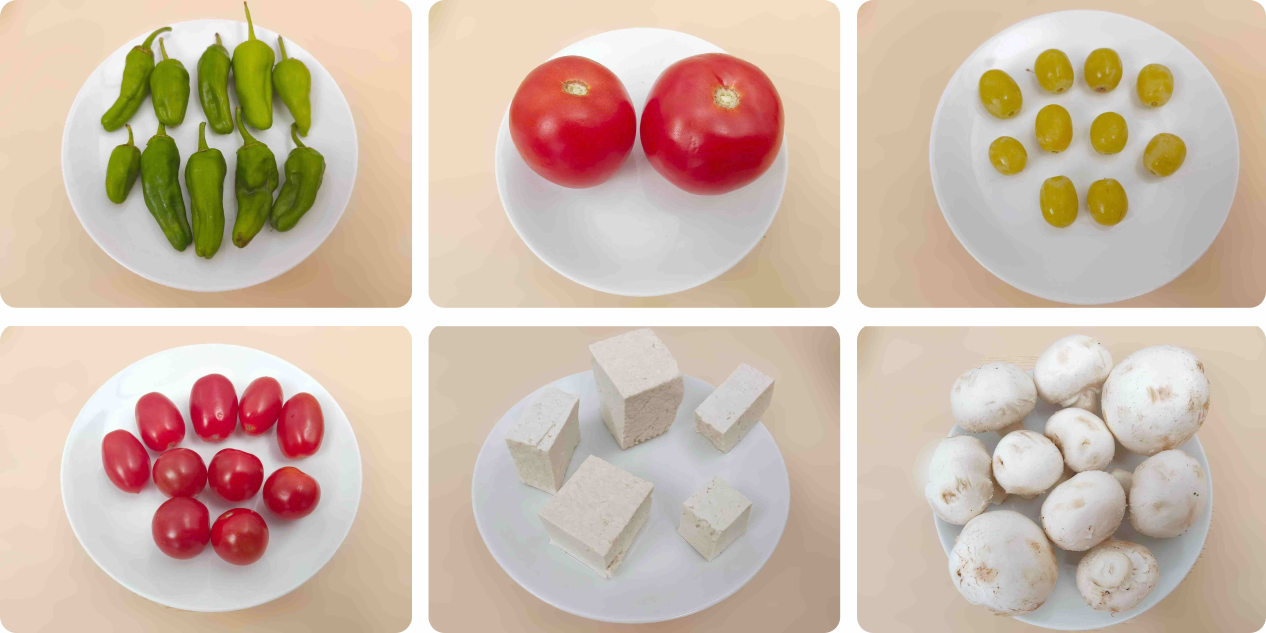
Training set
Real demonstrations used for the comparison policies.